
Cargo securing beams and bars
how do they work and which ones to choose?
Forankra offers shoring bars that are primarily used to block cargo during transport. They are widely used in vans, passenger vehicles, and trucks. There are bars with rubber feet and bars with fittings for rails. Shoring bars with rubber feet are suitable for vans with rigid walls, but the correct size must be selected to avoid damaging the vehicle roof. Bars with rail fittings are used only in vehicles equipped with cargo securing rails. Our offer also includes a wide range of cargo securing rails.
Shoring bars are made of steel or aluminum profiles, finished on both ends with rubber, replaceable feet or fittings compatible with cargo rails. Each bar has adjustable length, allowing one bar to fit multiple loading spaces. A major advantage is the possibility of replacing both the adjustment mechanism and worn-out feet.

How to choose the right blocking beam?
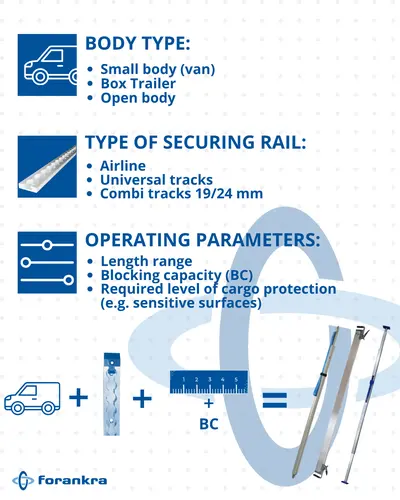
Selecting the right blocking beam is a key element of safe cargo transport. To ensure effective load securing, three main areas should be considered:
🔹 Vehicle body type
The type of vehicle determines the solution – different beams are used for vans, rigid bodies, and open transport.
🔹 Type of securing rail
Compatibility with the securing system (Airline, universal rail, or kombi 19/24 mm) ensures stable and safe positioning of the beam.
🔹 Operating parameters
Key factors include length range, blocking capacity (BC), and the required level of cargo protection – especially for sensitive goods.
Combining these three elements allows you to select a solution tailored to a specific application, increasing transport safety and improving working comfort.
Small body (box van) – aluminum shoring beams
In delivery vehicles, lightweight aluminum beams work best, enabling quick and convenient cargo securing.
SMARTBAR – a new generation of shoring bars
One of the most innovative solutions in this category is the SMARTBAR, developed by the R&D department. SMARTBAR is a modern blocking beam designed specifically for vans and light industrial applications.
Key features:
- Quick and easy installation – special handle allows spring tensioning without force
- Tool-free – manual length adjustment
- Click-lock system – fast adjustment and secure locking
- Ergonomic operation – shoulder-height handle reduces muscle strain (MSD)
- Lightweight design – only 2.5 kg, mainly aluminum (steel ends)
This solution significantly speeds up cargo securing and improves driver comfort.
Universal bars – flexible solution for various bodies
A practical solution is universal bars with adaptive end fittings. They can be used both in vehicles equipped with Airline rails and universal securing systems.

Main advantages:
- Compatibility with various securing systems
- Universal use across different vehicle types
- Quick adaptation to changing transport conditions
Available variants:
- Aluminum bars – lightweight, easy to use, ideal for frequent use
- Steel bars – durable, designed for heavier applications
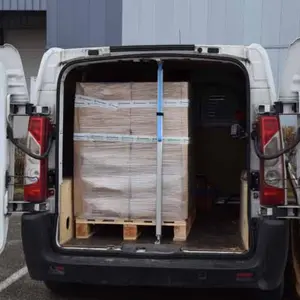


Box Trailer - blocking beams
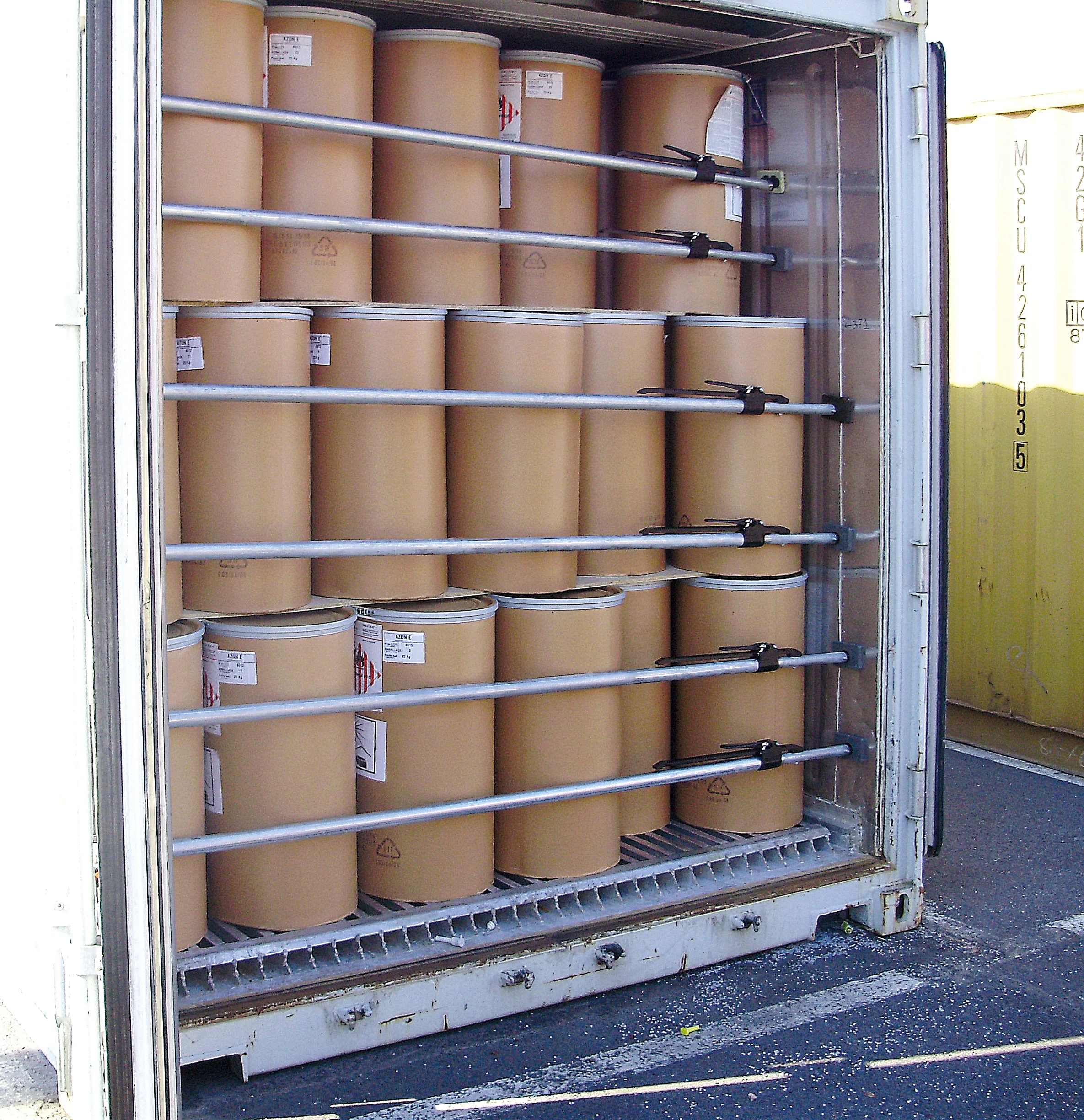
In closed bodies (e.g. box trailers, refrigerated trucks), blocking beams are used to create a solid barrier for cargo.
ERGOBAR – next-generation telescopic blocking beam
An innovative and patented solution is ERGOBAR – a telescopic blocking beam designed for industrial and urban vehicles with rigid bodies.
ERGOBAR enables effective cargo blocking thanks to even, controlled tension and extremely simple operation.
Key features:
- One-hand operation – quick and intuitive installation
- Ergonomic design – shoulder-height handle reduces muscle strain (MSD)
- Constant and controlled tension – even tension at 150 daN
- Cargo safety – flat surface minimizes risk of damage
- Parking position – beam stays in place after release
This solution increases transport safety and significantly improves operator comfort.


Open body – side beams
For trailers and vehicles with open bodies (e.g. platforms), side beams are the best solution, allowing quick cargo blocking against the side walls.

Side beams
One of the most popular cargo securing methods is blocking. In addition to classic shoring bars, side beams are often used, enabling quick and safe immobilization of goods by bracing against the vehicle sides.
Key features:
- Fast and easy cargo blocking without straps
- Mounted directly on vehicle sides
- Ideal solution for open transport
Design and functionality:
- Beam consists of two sliding parts – easy length adjustment
- Foldable – convenient storage
- Rubber ends – better friction and noise reduction
This solution significantly speeds up loading operations and improves transport safety.


Compatible securing systems
To fully utilize shoring bars and beams, mounting rails and dedicated accessories are used, enabling fast, stable, and repeatable securing in the cargo space.


Akcesoria do listewaccessories
Various accessories are used with rails to expand the system’s capabilities.
Most commonly used:
- Lashing points / fittings – for attaching straps or accessories
- Adapters and end fittings – to match different types of bars and beams
- Quick connectors – speed up installation and removal
Benefits:
- Greater configuration flexibility
- Ability to combine different securing methods (bars + straps)
- Optimization of cargo space
Mounting rails (Airline and universal)
Rails are installed on vehicle walls or floors and create a system of anchor points.
Purpose:
- Enable quick mounting of bars and beams
- Allow reconfiguration of cargo securing
- Increase safety through stable mounting points
How they work with bars/beams:
- Bar ends (Airline or universal) are attached directly into rails
- Height can be adjusted
- Ensure secure and repeatable positioning


Belki rozporowe naburtowe oraz systemy montażowe, takie jak listwy Airline, stanowią kluczowy element zabezpieczenia ładunku w transporcie. Dzięki nim możliwe jest szybkie i stabilne blokowanie towaru przy użyciu belek transportowych oraz systemów blokujących ładunek. Belki aluminiowe transportowe w połączeniu z listwami montażowymi zwiększają bezpieczeństwo i elastyczność konfiguracji przestrzeni ładunkowej.
FAQ – Frequently Asked Questions
A shoring bar works by applying pressure between the walls of a vehicle. Once adjusted to the correct length and locked in place, it creates a stable barrier that prevents the cargo from moving.
This depends on the size and type of the load. Typically, 2 to 4 bars are used to ensure proper stabilization.
You should consider the width of the cargo space, the type of vehicle, and the kind of load being transported. It is also important to match the bar ends to the securing system (e.g. Airline rails).
Most bars have adjustable length, but it is important to check the adjustment range and compatibility with the mounting systems in a given vehicle.


